
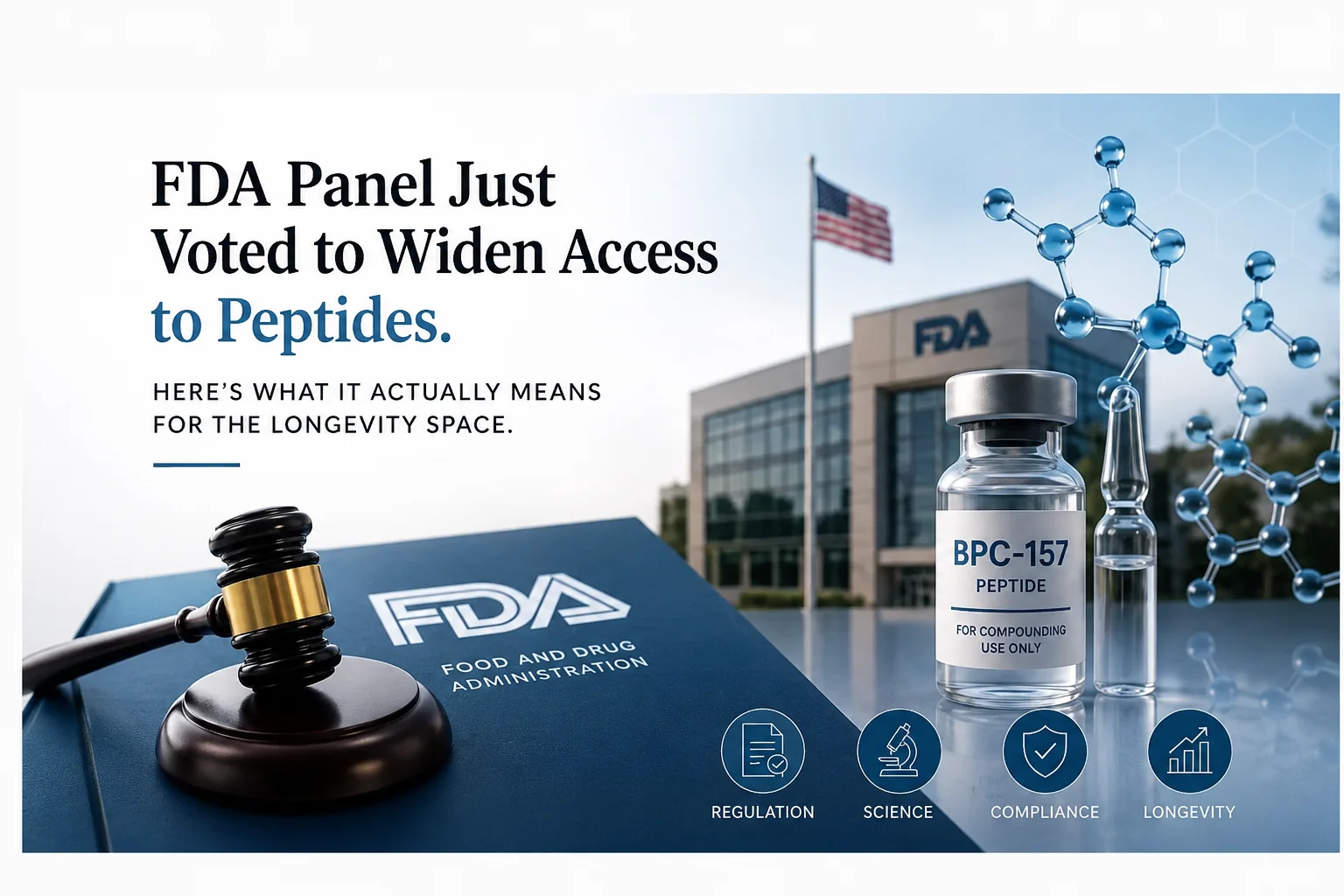
An FDA Panel Just Voted to Widen Access to Peptides. Here’s What It Actually Means for the Longevity Space
July 30, 2026 | Longevity Law Updates, Uncategorized
Article by: Tom Zuber and Carla Pareja Paris
What Happened Last Week
Last week at the FDA’s White Oak Campus, the agency’s Pharmacy Compounding Advisory Committee (PCAP) opened a two-day meeting to consider whether the seven popular peptides should be made easier to obtain through compounding pharmacies. The peptides on the agenda include BPC-157, KPV, TB-500, and MOTS-C (day one), with emideltide, epitalon, and others slated for review on day two.
In it’s first vote, the panel narrowly recommended- 8 in favor, 6 against, with one member abstaining- broadening access to BPC-157, a peptide that is a favorite among longevity and wellness circles and is marketed for tissue repair and reducing inflammation (it was formally nominated to treat ulcerative colitis). The room was split: of the two dozen speakers who addressed BPC-157, a handful of scientists urged caution while the majority – physicians, chemists, and peptide-business-owners- argued for expanded access, often citing patient and clinical anecdotes.
The backdrop is political as well as scientific. Loosening restrictions on peptides has been a stated priority of Health Secretary, Robert F. Kennedy Jr., while a number of career FDA scientist have pushed for caution, noting the thin human evidence base. One panel witness observed the BPC-157 has been studied in only about 30 people – a contrast frequently drawn against the far larger trials behind approved therapies. As one skeptic put it during the session, “anecdotes are not evidence.”
The Legal Machinery, in Plain English
Whether you run a biotech, deploy capital, or treat patients, today’s development reshapes the risk map in a few concrete ways.
-
**A potential complaint lane is opening – narrowly. **If a peptide lands on the 503A list, prescribers and compounding pharmacies gain a defined, patient-specific pathway. That’s meaningfully different from today’s status quo, and it rewards businesses positioned to operate inside the regulated channel.
-
**The grey market stays exposed. **Peptides sold online as “research use only” generally remain unapproved new drugs and are frequently misbranded. On top of the regulatory theory, there is real product-liability and contamination risk-clinicians at the hearing warned that unregulated injectable could contain impurities such as arsenic or lead. A favorable compounding vote does nothing to cure that exposure.
-
**Marketing claims are their own front. **Anti-aging, muscle-growth, and “re-verse aging” messages draws scrutiny from both the FDA (unapproved-drug and disease claims) and the FTC (substantiation of advertising). Influencer-driven promotion, which is central to this category, raises the profile – and the liability – of everyone in the chain.
-
**Regulatory status is now a first-order diligence question. **For funds, the distinction between an approved drug, a compounded product, and an unapproved gray-market, defensibility, and downside. Expect it to move up the diligence checklist for any longevity deal touching peptides.
-
**The rest of the votes. **The committee continues the week, and additional peptides are expected to come before it in the coming months. Each substance is decided on it’s own record.
-
Whether the FDA opens rulemaking. The real inflection point is a proposed rule and its comment period -a formal, on-the-record opportunity for companies, investors, and clinicians to be heard in the Federal Register docket.
-
**Your own classification and messaging. **Companies should pressure-test today how their products are classified, sources, labeled, and marketed. Small wording and supply-chain choices carry outsized legal weight in this category.
The Governance Wrinkle Worth Watching
There’s a process story running alongside the science. Reporting in the lead-up flagged conflict-of-interest concerns as temporary members were added to the panel – several ties to the peptide industry – to vote on some or all of the substances. That matters legally as well as optically: a rule that emerges from a process perceived as tilted is a more inviting target for challenge under administrative-law principles. In other words, how the FDA gets to the final list may end up as contested as whether it does. Anyone counting on a durable outcome should watch the integrity of the process, not just the vote tallies.
What to Watch – and What You Can Do Now
-
**The rest of the votes. **The committee continues this week, and additional peptides are expected to come before it in the coming months. Each substance is decided on it’s own record.
-
**Whether the FDA opens rulemaking. **The real inflection point is a proposed rule and it’s comment period -a formal, on-the-record opportunity for companies, investors, and clinicians to be heard in the Federal Register docket.
-
**Your own classification and messaging. **Companies should pressure-test today how their products are classified, labeled, and marketed. Small wording and supply-chain choices carry outsized legal weight in this category.
Recent Updates
An FDA Panel Just Voted to Widen Access to Peptides. Here’s What It Actually Means for the Longevity Space July 30, 2026
Generative AI Legal Issues: 5 Critical Questions Every Business Must Answer Before Deploying AI Solutions May 21, 2026
Medical Rescheduling, Recreational Risk: How Schedule III Could Reshape Adult-Use Cannabis February 18, 2026
Schedule III Cannabis: FDA’s New Frontier January 27, 2026
Data Privacy and AI in Longevity: Legal Risks Around Predictive Biomarkers and Health Data January 23, 2026
2026 Employment Law Developments: Key Takeaways for Employers December 22, 2025